Have you ever eaten somewhere that you eat all the time only to realize that you like more than you remember? Freebirds is that way for me! Freebirds world burritos Rocks! We ate there last night, and it's still on my mind, and possibly on my schedule for dinner tonight!
Friday, September 22, 2006
Good Stuff
Have you ever eaten somewhere that you eat all the time only to realize that you like more than you remember? Freebirds is that way for me! Freebirds world burritos Rocks! We ate there last night, and it's still on my mind, and possibly on my schedule for dinner tonight!
Friday, September 15, 2006
Tuesday, September 12, 2006
The Centering Prayer
Welcome back. Prayer can be a time of making our requests known to God. It can be a time of crying out for help. It can be a habit before a meal. We forget, though, that prayer can be a time of moving toward utter stillness and listening. This type of prayer is called Centering Prayer. In Ecclesiastes, Solomon reminds us that, as humans, we should be careful to approach the throne of God with few words, writing, “Go near to listen rather than to offer the sacrifice of fools, who do not know that they do wrong.” That stings a bit! I can almost see this sacrifice of fools in my own life: that I approach God with my busy life, offer many words that I think should be important to God, and go away the same man. Centering Prayer can be traced back to the writings of one of the desert fathers named John Cassian (c. 360 – 430), who came from the west to the desert to learn the ways of contemplative prayer. If you can get it, read his book, The Conferences. It’s a collection of his thoughts and conversations with the desert fathers written to acquaint the Western Church with the teachings of the desert fathers. In this work, he writes about a conference with Abba Isaac on the topic of true prayer. Abba Isaac prescribes a formula for prayer that will assist us “to maintain an unceasing recollection of God” by keeping it ever before us. The formula, Cassian writes, is this: “O God, come to my assistance; O Lord, make haste to help me.” Obviously, there is nothing magical or mystical in the mindless recitation of a mantra. But should you recite it with a heart-felt stirring, a desire for God to really do as you are asking, Isaac says the result is that “by God’s light the mind mounts to the manifold knowledge of God, and thereafter feeds on mysteries loftier and more sacred…the prayer wherein, like a spark leaping up from a fire, the mind is rapt upward, and, destitute of the aid of senses or of anything else visible or material, pours out its prayers to God.” [Pennington (1980) 11,12] It is this approach, brought forth by Cassian, that was the primary influence on monastic practice for over 1000 years.
In the 14th Century, there was an anonymous mystic who wrote The Cloud of Unknowing. This is the first of the spiritual classics in our language, and is a reaction to the intellectualization of theology and spirituality. This work admonishes follower of Christ to return to a prayer of the heart, giving techniques and ideas on moving into existential realities of contemplation and silence. This unknown mystic takes the prayer of Abba Isaac and combines it with the discipline of utter stillness and silence in an effort to accomplish a centering prayer. Johnston writes, “Here is what you are to do: lift up your heart to the Lord, with a gentle stirring of love desiring Him for His own sake and not for His gifts. Center all your attention and desire on Him and let this be the sole concern of your mind and heart. Do all in your power to forget everything else, keeping your thoughts and desires free from involvement with any of God’s creatures or their affairs in general or in particular. Perhaps this will seem like an irresponsible attitude, but I tell you, let them all be; pay no attention to them.” [Johnston, ch. 3]
Unlike the Jesus Prayer, it’s not a repetitive model. The one praying is encouraged to choose a simple, monosyllabic word, like “hope” or “Christ.” During this time, when the mind is distracted or chooses to wander, the word is used to bring it back to focus. In The Cloud, this silence is pointed to as the quiet of Elijah in 1 Kings 19. The NRSV calls it “sheer silence.” The anonymous mystic also points to Mary sitting at the feet of Jesus in Luke 10. While Martha goes about the rigors of preparation and necessary tasks of the “active life,” Mary sits at Jesus feet serving as an example of the contemplative life. In the midst of the busyness of the moment, Mary forgot all and was completely wrapped in His presence, turning to Him with all of her heart. It’s not that she observed Him, noting His body, voice, or odor, but she centered on Him and is basking in His love for her. This is what makes Centering Prayer different from Ignatian meditation (a form of meditation where the one meditating place themselves into the Biblical narrative and imagines being there in the action as the narrative unfolds around them).
In Practice, the Centering Prayer has been practiced with many minute differences, but these 5 steps are the essentials that seem to be in common with all of the various forms.
Step 1: Find a place to sit comfortably, and with your eyes closed, let yourself settle down. Let go of all tensions, worries, thoughts, sensations you feel and think about God’s love for you. Begin to rest for the moment in God’s love as Mary did. Remember, He is the God that dwells in you.
Step 2: Effortlessly, take up a word, a symbol of your desire/intention to give yourself completely to Him and His presence, and let that word be gently present, a murmur of your mind rather than an asserted point. The word should be monosyllabic and should communicate God’s love to and for you.
Step 3: When you become aware of your thoughts, or you begin to notice sensations, or as internal sensations arise, use that as a signal to return to your word again. This helps to affirm your desire to separate from the external and to go rest in God’s presence.
Step 4: If your thoughts do subside and you find yourself resting or restfully aware, you can even let go of the word. Just be in that stillness. When thoughts begin to stir again, gently return to that word. Answer your thoughts with that one word. For instance, as I practiced this method, my word was “peace.” As I sat in silence, and began to rest, my mind drifted to a retreat I was planning for. My internal “to do” list popped up. But, in response to that desire to plan/prepare/work, I said, “peace.” “Jason, you need to be getting ready.” “Peace.” What if no one shows up?” “Peace.” What if it doesn’t go as planned?” “Peace.” “peace” was my response to my thoughts, questions, and anxieties.
Step 5: At the end of your prayer time (I’m working towards 20 minutes in the morning and 20 in the evening), take a couple of minutes to come out of the silence, like coming back into reality at the end of a massage. This is a great time to express your thanks to God for His care for you, and to lift others to Him for His care.
Give it a try. See what happens, and check back for more later. If you’d like to read more about his topic, and some of the others I’ve been talking about, check out www.lectiodivina.org/centering .
Peace
Wednesday, August 30, 2006
The Jesus Prayer
The Jesus prayer began, so it seems, as one young man's attempt to discover how to really pray without ceasing. In his travels, he discovered an old hermit that explained to him that "The ceaseless Jesus Prayer is a continuous, uninterrupted call on the holy name of Jesus Christ with the lips, mind, and heart; and in the awareness of His abiding presences it is a plea for His blessing in all undertakings, in all places, at all times, even in sleep. The words of the Prayer are: 'Lord Jesus Christ, have mercy on me.' Anyone who becomes accustomed to this prayer will experience great comfort as well as the need to say it continuously. He will become accustomed to it to such a degree that he will not be able to do without it and eventually the Prayer will flow from him." {Jones p. 60} The hermit pointed the young man to the ancient writings of Desert Fathers in a collection called the Philokalia. Through the use of a prayer rope and this prayer, the young man began to build this prayer into his life as a repitition, a habit that became an essential part of his life. The young man later travels the country side of Russia teaching this prayer to all who would learn. You can read about his travels in the anonymous book The Way Of The Pilgrim, a journal of his travels.
His discovery has actually been a foundational part of Eastern Christianity since the early 1400's. It seems that this practice of the Jesus Prayer can be traced back to Abba Philemon of the sixth century. The Jesus Prayer is a combination of Greek asceticism (excercise/training) and hesycahsm (quietness) seeking to combined the mind and heart in a unified prayer. The early church fathers taught that when this is accomplished through the quieting of the mind and focusing of the heart (through the use of this simple repetitive prayer/phrase) the believer will be illuminated, particularly with the truths fo Scripture. This Jesus Prayer speaks to the very nature of our travails in life; the fact that God is always ready to enlighten us, but our own nature seldom remembers the need for it.
In our times, the Jesus Prayer has been amended to have a tag that makes it read like this: "Lord Jesus Christ, Son of God, have mercy on me, a sinner." I prefer to leave the last phrase off because I am no longer a sinner if I've been redeemed by Christ. The New Testament calls me a saint. However, if the goal of this repetetive prayer is to remind us of our need for God's mercy, it may be an appropriate tag for the exercise. As I've put this into practice, trying to recite it as many times as I can during the day, I am finding that as my mind quiets, my lips purse and the prayer comes out. It's bleeding into my subconscious. The practice has become somewhat of a mantra for me. The desert fathers suggested recitation of this prayer upwards of 5,000 times a day! I'm nowhere near that, but with this prayer on my mind, it slips into my day and reminds me contstantly of my need for Christ Jesus.
In practice, I've tried to focus on a rhythmic pattern. As I breathe in, I say, "Lord Jesus Christ, Son of God." Then, as I exhale, I finish, "have mercy on me." Give it a try and let me know how it goes for you. It's been a great thing for me.
Next up, centering prayer...
Tuesday, August 22, 2006
Silence And Solitude
"Hectic" best describes most of our lives. "Noisy" and "Busy" come to mind as well. The wisdom of Proverbs admonishes us, "The tongue has the power of life and death, and those who love it will eat its fruit." (18:21) The Scriptures attest to this in several places. The ancient fathers bear witness to its truth, as well. And yet, we live lives that are contrary to the consensus of these witnesses. They agree that much talking is a vice and that silence is a virtue. I know I forget that often. The greatest witness to this is Jesus, Himself. Although He taught publically, He also valued times of silence and solitude, seeking to emerse Himself in prayer and reflection. He also prepared for times of distress with times of solitude. But that word frightens many of us today. Solitude, silence, the idea of being alone and left to ourselves rattles us. For the Christ-follower, we're never turly alone, and silence is only a greater opportunity for us to listen. To quote the book I'm reading, "All in all, no spiritual discipline is more universally acclaimed as necessary than the practice of silence." Rufinus, Jerome, Benedict, and even modern day pilgrims like Willard and Foster commend silence as a necessity. But why solitude? It really isn't about withdrawing to avoid evil or people. It is about posturing ourselves to better listen to The Father. Richard Foster, one of my favorite all time writers, connects solitude with silence, saying, "Without silence there is no solitude. Though silence sometimes involves the absence of speech, it always involves the act of listening. Simply to refrain from talking, without a heart listening to God, is not silence." The need to listen requires silence, and the need for silence requires solitude. It's no wonder that with all the noise of life (iPods, CD players, TV, cell phones, etc.) that we have a hard time hearing God's voice. All of the ancient writings point toward silence and solitude being foundational in developing our love of God, self, and others.
In addition to needing to hear from God, silence and solitude provide us the opportunity to find what we can learn from ourselves without the external stimuli that are around us. St. John of the Cross (1542 - 1591) says that this type of silence often leads to The Dark Night Of The Soul. We can't truly pursue silence without ending up in a season of deep dark doubt where we hear nothing but our own depravity. Our desire to be plugged into God, fully listening and fully aware brings us to a place of dealing with that which hinders us most: ourselves. But when we enter into that lonliness, that deep dark doubt of our own inner struggle, we emerge with more patience and fortitude. We hear and are made stronger for it. Our faith is bolstered. We become aware of our true selves when we're "swallowed up" in God; realizing the freedom of being rather than doing. And when we discover this new self, fulfilled only in our immersion into Christ, we begin to bear fruit. It is in The Dark Night Of The Soul that the soil is replentished. Then the seed takes root and fruit is produced. John Climacus writes, "Intelligent silence is the mother of prayer, freedom from bondage, custodian of zeal, a guard on our thoughts, a watch on our enemies...a companion of stillness, the opponent of dogmatism, a growth of knowledge, a hand to shape contemplation, hidden progress, the secret journey upward." Richard Foster's quote on the product of silence and solitude bears great weight in whether it is worth the pursuit, He writes, "the fruit of solitude is increased sensitivity and compassion for others. There comes a new freedom to be with people. There is a new attentiveness to their needs, new responsiveness to their hurts." Summary? Being quiet and being alone on a regular basis makes us better people and better disciples. It makes us more useful, more set apart and more aware of the work of Christ in and around us.
Will you join me in the practice of regular silence and solitude? I am building into my life this discipline by working out 2 hours a week (not necessarily consecutive) of silence. I will be building to a 1/2 day a month and a two-day retreat a year. I've already contacted a monastery in Pecos, NM, about the use of their facility. Like any other worth-while things in our lives, we must make them a priority and get them on our calendar. Will you put silence and solityde on your calendar?
Friday, August 18, 2006
Lectio Divina
All too often, Christ followers come to the Holy Scriptures for advice or to prepare for a lesson instead of a contemplative reading that allows Scripture to shape us as God sees fit. I know that my life is full of reading. That reading is usually around an event or a need, rather than a contemplative or meditative reading. Sound familiar? Thomas a Kempis counseled believers saying, “Do not read to satisfy curiosity or to pass the time, but study such things as move your heart to devotion.” The Scriptures and early church fathers testify that by entering deeply into the text of God’s Word as a believer gives God an avenue to reveal Himself to us, to speak to us, and to direct our lives. Paul affirms this in 2 Tim. where he says that Scripture is inspired and profitable. St. Benedictine (c. 480 – 550) found this such a primacy that he built it into the practices of his monastery, cementing this practice into Western Monasticism. Indeed, on this topic of Divine Reading, Guigo II (c. 1115 – 1198), the ninth prior of the Grand Charteuse (a Carthusian order in France), gives us great insight into what he called “The Ladder Of Monastics.” He says divine reading consists of four “steps” that I want to encourage you to put into practice this very day.
The first step is reading (lectio). Find a distraction free place, which is hard to do in our society. Also, grab a copy of God’s Word that is free from distraction. That is, find an easy to understand translation. I would also encourage you to get something that flows freely without study notes. Too often we allow the study notes to be what we take from God’s Word, and not The Word Himself. The New Jerusalem Bible, or the William’s NT are great for this. Sometimes we don’t think our reading places through, and a lack of light, or a stirring hunger, or a lack of sleep keep us from giving the text our full attention. We must give this time of lectio divina our full effort. Once you have all the distractions removed, choose a text and ask for/expect direction and insight from God.
Oh, one other thing; read slowly! Savor each word. Educator Michael Casey reminds us, “we need to slow down, to savor what we read, and to allow the text to trigger memories and associations that reside below the threshold of awareness.” As you read in this fashion, some things will stand out to you. That brings us to the second step.
The second step is meditation (meditation). During meditation we grasp the “interior intelligence” of the text. We wrap our minds around the values, the underlying assumptions, and the presumptions of the passage. It’s in attending to these deeper meanings that we begin to meditate. Dwell on the things that stand out to you, and explore the feelings and emotions that are conjured in your inner being. Embrace the sorrow of lamentations, the joy and sorrow of the Psalms, the tension and passion of the Passion week. Explore and chew on what your mind is fed.
The third step is prayer (oratio). Engage The Father in meaningful conversation about what you’ve just taken in. Allow Him to speak to you in the moments that follow. The Master Teacher wants to instruct and embrace you with His guidance, wisdom, and direction.
The last step of the lectio divina is that of contemplation (contemplatio). This final step will prove to be the hardest of the four. True contemplation drives us beyond words and intellect; into what Tony Jones calls the “thin space” where time and eternity almost touch. He says, “It’s in moments like these that some of the greatest saints in the history of the church have had a ‘mystical union’ with Christ. This step requires us to imagine our existence in the new paradigm of what God has just shown us. To think back to how life would be had we already been practicing the lesson of the Teacher, and to think ahead to how life will be different marks real contemplation. Don’t just converse with God about the lesson of the reading, ask Him to paint a picture so vivid it’s beyond description. Contemplation is the embracing and dreaming of that vision.
A lot to chew on, I know, but worth the effort. Next up will be Silence and Solitude. Enjoy.
Wednesday, August 16, 2006
The Shaping Of A Soul
Friday, August 11, 2006
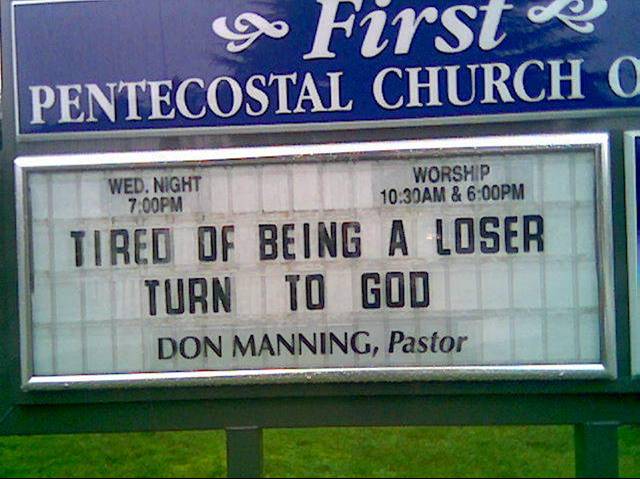
Signs, Signs, Everywhere there's signs...
Planting a church has opened my eyes to many things church related. I've noticed how many churches choose to market themselves through their marquees. Living in the Bible belt, I see lots of church marquees. And I'll start by saying that I've never seen a good church marquee. I quite often ask myself, "What were they thinking?" Seriously, do these marquees bring people into the kingdom? Do people drive by and say, "You know, they are right. I need to go to that church."? If you know someone who came to faith because of a church marquee, would you comment about it below?The signs I see are mostly Christian wittisisms that speak to the people inside more than they speak to the people outside. If they do speak to the people outside, it's usually negative because the people inside don't understand how to speak to those on the outside. A church marquee near my home dares people to try their web site. If they really understood people, it would double-dog dare you to try their web site. One sign says, "Tell Satan to go to hell...He needs to go home." If you are reading this, and you are in charge of your community's signage, just put your service times up, or special events you're having. As a tool for advertising, advertise your product instead of saying, "Come inside...We're prayer-conditioned."
Here's the real point, though: Your people should be your signs. Jesus made that clear when He said things like, "By this all men will know you are My disciples, if you love one another." or "Let your light so shine before men that they see your good deeds and they glorify your Father in Heaven." Trust me, people living missional (making disciples) and incarnational (the presence of Jesus in the real world) lives are a much better outreach tool than your marquee.
Wednesday, August 09, 2006
WOW!
During my trip, I noticed a couple of church signs that were thought provoking. I'll post on that soon.
While I'm thinking about it, check out where this blog got mentioned: http://www.sbtexas.com/default.asp?action=article&aid=3060&issue=7/31/2006
My friends Stephen and Roy are cited their, too. So, I'll be back later with my thoughts on church signs.
Peace,
Jase
Saturday, July 29, 2006
Routines, Cocooning, And Sabboth
I'm ready to get back into the routine of the school year. I just don't think I can jump back into the routine and hope for calm. I must receive my calm from The Calmer, and then slip into the routine. On top of that, though, I really feel that this semester will be one of supernatural progress for our family and our church. So pray for us, and pray that we are not blinded to the supernatural by the routine. And be sure to build some cocooning time into your schedule. You'll fare better.
Friday, July 21, 2006
Home At Last!
Peace - J
Tuesday, July 11, 2006
Super Summer

One of the things about Student Ministry that always made the work more challenging is the fact that you have such a diverse group when it comes to interest in all things spiritual. I would spend a lot of time trying to figure out how to impact the student who really wants to dig into God's Word AND the student whose parents drug him/her to the church and the last thing they want is to listen to me...It could be frustrating at times.
But this week I am at a leadership training event for students who want to be better equipped to lead, Super Summer. I've been involved with Super Summer since 1989, and this will be my 23 session to serve in some capacity. It's my privelege to be Dean of the Orange School (students entering 10th Grade). We have 170 students and 30 adults in Orange School this year. My responsibility is to lead this group in teaching (with the help of my Asst. Dean - Michael Murrie and my Team Leader Coordinators - Goose Gast and Mark Tissue), worship (with the help of Jake Turner), and recreation (our 22 Team Leaders). I love it. Here's a couple pictures of the students arriving yesterday.
Thursday, July 06, 2006
The Drive In Movie
Drive in theaters rock! I always seem to forget that when it comes movie time. Last night I took my family and our youth group to see "Cars" and "Nacho Libre" at our local drive in. The movies were good, but that's not what makes the drive in great. The drive in experience includes several elements that make it a great time:
1) A Community Enviroment - we all brought lawn chairs, blankets, pillows, and pulled our cars/trucks together to watch a movie as a group. We could talk, share food, and enjoy the experience together.
2) Cost effective - in many ways, the drive in provides current movies at prime times for low costs. My kids got in free, and Caryn and I were $5 each. The WHOLE family got into Cars for $10! The drive in also realizes that you can bring your own food, so they price their food and beverages to sell, not to bankrupt you. We ate a late dinner last night for $15. That included corn fritters, nachos, hamburger, corn dogs, and two "glow stick" bracelets for the kids. At the indoor theater, our tickets would have been $25 for our family, and an additional $20 for snacks. Add to that the fact that we could also bring a cooler full of stuff with us, and it's hands-down the most economic movie option for a family.
3) Memories - my kids will always remember sitting in the back of my truck as a family, sharing food and drinks, sharing laughs, and not having to be told to sit still, be quiet, calm down, or anything else you may have to say in an indoor theater. They will also remember sitting in mommy and daddy's laps and snuggling when it got cold (it got really cold last night). I still remember going to the theater with my family for the all-night Godzilla movie marathons. It was a magical time for me that I get to share with my kids. My 4 year old daughter just smiles when we talk about it, and says, "That was fun, daddy." My 6 year old son was amazed at how bright the projector was and how big the screen is.
We'll be going back soon, and I hope you will join us at the drive in. It's a great piece of American history and a good lesson in community.
Friday, June 23, 2006
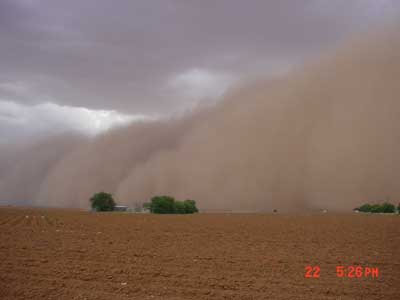
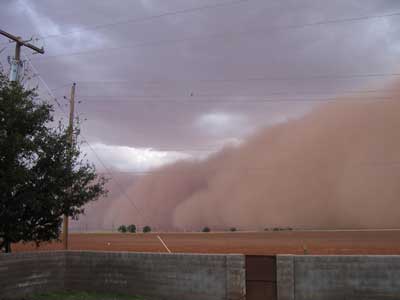
The West Texas Winds
Thursday, June 22, 2006
When Cleaning the Men's Room...
It's important to wear gloves. But, if you wear gloves and then wipe the sweat from your forehead with your hand that is wearing the aforementioned gloves, you've defeated the purpose of wearing said gloves... It's about the same as putting your hands on your knees while wearing those same gloves...
Wednesday, June 21, 2006
Oh, the agony
Not that I'm superstitious, I guess the real problem was with the Dallas city council announcing the Championship Parade Route after game 2. What were they thinking?
Friday, June 16, 2006
Going, Going, Gone
I've known Elaine for almost 2 years. She's a relatively new friend, but I've had the privelege of watching the "lights come on" for her in reguards to missional living. Having grown up Church of Christ and then non-denom., what we started at The Journey stretched her sometimes. But she gets it. And, more importantly, she's started living it and teaching it to others. She and Nathan are funny, and fun to be around. They will be sorely missed as they head off for the next chapter of their lives at seminary in Ft. Worth.
Nate & Elaine, thanks for all you've done; your generocity and kindness, and your willingness to step in and do what needed to be done. Do well, be blessed, and keep the faith. More than anything else, cling to Jesus. And always know that you have family in Lubbock.
Peace - Jase
Thursday, June 15, 2006
Unpacking Origins Pt. 3 - Creativity
It's so great to be home, even though the rafting adventure was GREAT!
If you've never rafted, you should give it a try. This was my 4th trip down the Arkansas river. I've hit the Royal Gorge three times. This trip was much more leisurely, though. We had several beginners and one girl from our group who was 12 years old. So, we did Big Horn Canyon. As you can see by the picture, the Royal Gorge can be brutal. But Big Horn Canyon was two soild class III rapids and the rest was just floating at about 2450 cfs. I had a lot of time to enjoy and think as we just floated the 22 mile trip. And, as has happened a lot lately, my thoughts drifted back to Origins. In Romans 1, Paul reminds us that God's invisible qualities are revealed in His creation. The beauty of the canyon reminded me that we have a very creative Deity. Since we are created in His likeness, we are designed with this same creative bent. Too many people think that they must be artistic to be creative. The truth, though, is that as humans we are creative. All of us. We're just creative in different ways.
So, here's my dilema: it seems that much of what we do as a church looks like some sort of cloning of the world around us. I've mentioned this before (Cloning Culture), but with a different emphasis. As I think about this now, I realize that we stiffle the creativity of people by asking them to replicate safe versions of things we find in our culture, or to plug into our prepackaged model that someone else has had success with. As the body of Christ, we possess all the creativity we need to be what the church ought to be; a relevant expression of faith and spirituality to a hopeless world. Navigating The Journey means I am charged with unveiling and unleashing the creativity of our people. Instead of trying to plug them into the mold that I envision, I should be striving to help them develop their character and tap into their divine creativity so that they can do life as God intended. I am giddy with anticipation of a faith community that God uses to impact our culture in a way that no other community can because of the individuals He has brought together for The Journey. The challenge for me is to get out of the way and let the body be the body in a wonderfully diverse and creative way. Instead of designing a plan, simply cast the vision and allow the body to uniquely and creatively accomplish the vision.
Wednesday, June 07, 2006
Convection Oven Speed Ball
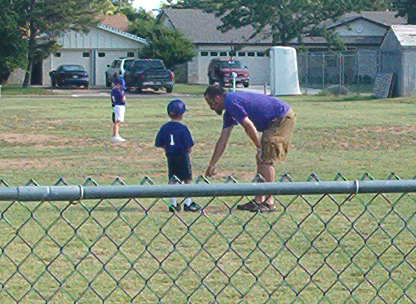
Imagine coaching a baseball team...well, a t-ball team that uses a baseball. Now imagine that team being made up of boys and girls ages 4 - 6. Add to that the fact that it's 105 degrees here in Lubbock, and you can begin to imagine what our first t-ball practice was like last night.Many of you know of my love for baseball, and that I played ball into college. I love the sport, and was excited that my children have shown an interest in America's sport. So, in my excitement, I signed on to be an Assistant Coach for the Orioles, Jeremiah and Cayla's team. My traveling schedule and my work schedules really prohibit me from doing much more than that, or so I thought and explained to the lady who told me last Thursday that I was THE coach for the team. It seems that as the only one to say I would help, I got the whole thing. And it doesn't matter that I'll be gone for 5 of the 11 games...
So, last night we had our first practice. My team has 13 kids on it, 12 of whom showed up, and most of whom have never played. So, in the 105 degree heat, I did my very best to teach, hold their tiny attention spans, and still make progress. It went pretty well, I think. Caryn made much of it happen with the behind the scenes prep (snacks, etc.). Try to imagine playing t-ball in fast forward speed while in a convection oven and you'll get a feel for how it was last night. But this is the ideal thing for me/us to be involved in. The Journey will sponsor the practices, helping with the kids, and serving the snacks at every practice. We'll build relationships with the kids and their parents. The season lasts through July 17th, so we have a few weeks to get to know the families involved. Pray for us! PRAY FOR ME! Tomorrow night, I'll get there early to work with one of my boys, Roosevelt, who has potential to throw both ways. His dad mentioned that he'd love for Roosevelt to learn to do both, so I told him we'd meet early each week to work on it.
And for all you Journey pilgrims, thanks for your help with the snacks last night. If you want to come and help with practice tomorrow night, be there at 5:15 (same place).
Thursday, June 01, 2006
Unpacking Origins - Pt. 2
1) How much more knowledge do we need? I am constantly reminded that James said that those who hear and don't do are like men who look in the mirror and immediately forget what they saw. Please hear my heart on this. Being one who has a master's degree in divinity, I see the importance of knowledge and study. I've been a student of some sort all my life. But what good does it do for us to have more and more knowledge that we never apply? Sure, we could win Bible Jeopardy, but we're losing our communities. As more and more churches strive to find the right program for their people to have a deeper faith, they need to ask how their people are already putting into practice what they are learning. Maybe the best discipleship model would be to find someplace to spend your free time and practice what you've learned before we move onto the next thing to learn... I am reminded of a story about a young Pastor who came to his new church and preached a great sermon on his first Sunday there. The people were amazed. Then, the next Sunday he preached the exact same sermon. The people were a bit confused, but it was a good sermon, so they didn't mind too much. The third Sunday he again preached the same sermon. The people were a little put out. So much so, that the head Deacon approached the young Pastor after the service and pulled him aside. When the Deacon asked the Pastor if he realized he'd preached the same sermon for the last three weeks, the Pastor responded with, "Yes, I know. And once we start living that one, I'll get onto the next one."
2) Who was the focus of New Testament discipleship? When Jesus told Peter to feed His sheep, Pete didn't call the 12 together for a weekly Bible study on living with purpose and meaning. Instead, he went and proclaimed Christ to the people of Jerusalem and 3,000 were saved. Looking at the Great Commission of Matthew 28, we see that making disciples is tied heavily to the proclamation of Christ as savior and people coming to faith. I believe that we have greatly misunderstood that discipleship includes everyone, especially those who have not yet embraced the faith. Since the ultimate goal of discipleship is making disciples, consider this in light of Merriam-Webster's definition of a disciple: "one who accepts and assists in spreading the doctrines of another." As disciples, discipleship is the calling of our lives. And in it's purest form, discipleship is accepting and spreading the doctrines of another (in our case, The Christ).
How do I unpack this? It's paramount that I know the doctrines of The Christ in order to live well and and to teach them to others, especially those who need to be saved by Christ. But I can't wait until I know all I need to know. Like Peter, what I know at this point must be shared. Like Paul, I understand that I must pass along what I know to those who will be faithful to pass it on to others. Christ's call for each of us is to make disciples while being disciples ourselves. I firmly believe that the future leadership of The Journey will be people reached through the discipleship process; that is the spreading of the kingdom and the spreading of the doctrines of Christ. In those we reach, we will invest. This is discipleship, and it's how people will realize their great potential for the kingdom. That potential is what I'll "unpack" next.
Peace